
Investing in a company can take different forms, such as purchasing shares, which gives investors an ownership stake in its capital, or buying bonds issued by that same company, which makes investors creditors by lending money under the terms established for the issue. This is a fundamental distinction when understanding what to expect from each investment and assessing which strategy is best suited to each investor’s objectives and profile.
In the case of conventional bonds, interest payments and repayment of the nominal value on a specified date are generally предусмотр, which can provide a degree of predictability regarding the financial cash flows associated with the investment. However, these commitments depend on the issuer’s financial capacity. Therefore, the existence of a defined interest rate should not be confused with an absence of risk or an absolute guarantee that the invested capital will be recovered.
Although the coupon is often one of the elements that attracts the most attention from investors, analysing a bond requires consideration of a broader range of factors. These include the issuing entity and its geographical and sectoral context, the investment term, the purchase price, repayment conditions and the terms offered by competing investments. Understanding how these elements interact is essential to assessing not only the potential return but also the risks associated with the investment.
But what distinguishes different bonds in practice, and how do their characteristics influence an investment? To better understand this financial instrument, it is important to become familiar with the key concepts underlying how it works.
The Issuer and the Terms of the Issue
The issuer is the entity that seeks financing through the bond market and may be a public or private organisation. By issuing bonds, it undertakes a series of commitments to investors, particularly the payment of the agreed interest and, in the case of conventional bonds, the repayment of the nominal value at maturity.
The issuer’s financial capacity is therefore one of the main factors to consider, as its ability to fulfil these obligations depends on its economic and financial position. This is where credit risk becomes relevant, referring to the possibility that the issuer may be unable to meet all or part of its obligations to investors.
Among the terms established at issuance is the nominal value, which represents the reference amount of each bond and serves as the basis for calculating interest and, typically, the repayment of principal at maturity. However, it is important to distinguish this value from the purchase price. When traded on the secondary market, a bond may be purchased at a price above its nominal value (above par) or below it (below par), influencing the investment’s return.
Another relevant element is maturity, which corresponds to the scheduled date on which the bond becomes due and, as a general rule, its nominal value is repaid. Understanding this timeframe allows investors to assess the investment horizon and its suitability for their financial objectives, bearing in mind that different bond structures exist, some of which may include specific early redemption provisions or have no defined maturity date.
The Coupon and Interest Payments
One of the concepts most commonly associated with bond investing is the coupon, which represents the remuneration established for the security and, in bonds with periodic payments, corresponds to the interest received by investors throughout the investment period.
The way in which interest is calculated and paid depends on the terms established at issuance, making it important to distinguish between the coupon rate and the frequency of payments.
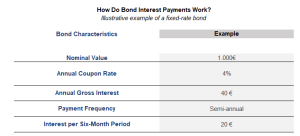
For illustrative purposes only, assuming a fixed-rate bond with semi-annual payments and the issuer’s fulfilment of its obligations. Amounts are stated before taxes and charges.
This payment frequency may vary between issues, as may the nature of the interest rate itself, which can be fixed or variable. In fixed-rate bonds, the coupon rate is determined in advance and remains unchanged throughout the specified period. In floating-rate bonds, remuneration follows the evolution of a reference rate, in accordance with the established terms. There are also zero-coupon bonds, which do not distribute periodic interest, with returns generally arising from the difference between the purchase price and the amount received at maturity.
Understanding these differences helps investors assess how an investment may generate income over time, particularly when the objective is to receive regular cash flows or manage the distribution of income over a specific investment horizon.
From Subscription to Increasing an Investment Position
Bond investments can be made at different stages, either by subscribing to a new issue (primary market) or by purchasing securities already in circulation on the secondary market. Although both transactions provide exposure to the same type of financial instrument, the acquisition conditions may differ, particularly in terms of price and expected return.
When a new bond issue is launched, investors may express their intention to purchase bonds by submitting a subscription order, formalised, where applicable, through a subscription form. This document identifies the information required for the transaction but should be considered alongside the documentation provided by the issuer, particularly the prospectus, where applicable, and the terms of the issue. These documents describe the instrument’s characteristics, associated risks and payment and redemption commitments.
Following the initial acquisition, investors may also choose to increase their exposure to a particular bond issue by purchasing additional bonds, a transaction commonly referred to as increasing an investment position. When carried out on the secondary market, this additional purchase depends on the availability of the securities and the prevailing trading conditions, and may take place at a different price from the original purchase.
For this reason, the decision to increase a position should take into account not only the bond’s characteristics but also the specific conditions of the additional acquisition, as these may influence the overall return on the investment.
Market Price and Yield
Although bonds are frequently associated with the possibility of receiving periodic income, it is important to remember that their value may fluctuate over time, particularly when they are traded on the secondary market.
For conventional fixed-rate bonds, these fluctuations are influenced, among other factors, by changes in market interest rates.
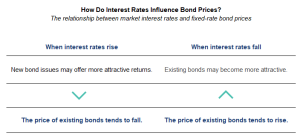
This relationship is generally observed in conventional fixed-rate bonds, all other factors remaining constant.
Changes in the issuer’s financial position may also influence the market price, as shifts in the perception of its credit risk can make the securities more or less attractive to investors.
These fluctuations are particularly relevant when an investor intends to sell a bond before maturity, as the amount received may be higher or lower than the original purchase price. Furthermore, the ability to complete the sale depends on the bond’s liquidity, meaning the availability of interested buyers under prevailing market conditions.
In this context, it is also important to distinguish between the coupon rate and the effective yield, since the return provided by a bond does not depend exclusively on the interest received. The purchase price, the amount obtained upon sale or redemption, associated charges and applicable taxation are also determining factors in calculating the investment’s overall result.
Consequently, two bonds with the same coupon rate may generate different returns, depending on the conditions under which they are purchased and whether the investor decides to sell them or hold them until maturity.
An Analysis That Goes Beyond the Interest Rate
Investing in bonds therefore involves a range of characteristics that should be assessed together, as potential returns, investment horizons and risks are directly related to the specific terms of each issue.
Understanding the issuer, how interest is calculated and paid, the conditions of acquisition and redemption, and changes in market prices all contribute to a more comprehensive and informed analysis.
Rather than considering the coupon rate in isolation, it is important to understand how each bond fits within the investor’s overall financial portfolio, financial objectives, investment horizon and risk profile, enabling more informed investment decisions aligned with their strategy.
This communication has been prepared by Banco Finantia for information purposes only and does not constitute investment advice or a recommendation to invest. In preparing this communication, no consideration has been given to any investor’s investment objectives, financial situation or specific needs. Accordingly, the information has not been tailored to any actual or potential investor, nor have any particular circumstances relating to such investors been taken into account.
The information provided is based on market conditions prevailing at the date of publication and on information obtained from recognised third-party sources of a public nature. Banco Finantia has not independently verified the data or information provided by such sources. By receiving this communication, the recipient acknowledges this fact and agrees that Banco Finantia shall not be held liable under any circumstances for any errors, omissions or inaccuracies contained herein or arising from the use of this information. Banco Finantia accepts no responsibility for any direct or indirect loss or damage that may result from transactions undertaken on the basis of the information provided.
Banco Finantia’s investment activities, whether conducted for its own account or on behalf of its clients, are entirely independent of the content of this communication. The Banco Finantia Group may hold positions in, or trade, the securities or financial instruments referred to herein before or after the publication of this communication and may provide, or seek to provide, banking services to the issuers of such securities or financial instruments.
Banco Finantia is supervised by the Portuguese Securities Market Commission (CMVM) and is registered with the CMVM under registration number 109.